There is a particular kind of offshore race that looks gentle from the outside.
No breaking seas. No green water. No crew clawing along the foredeck at three in the morning. No rig damage. No heroic photographs. No story of survival sufficiently dramatic to earn the bar's full attention, or perhaps one involving an anchor and a knife!
Just light wind, long hours, a soft sea, a clear sky and a race that quietly asks the same question again and again.
Are you still thinking properly?
The Myth of Malham race - from Cowes to the Eddystone light house off Plymouth The 2026 RORC Myth of Malham asked it a lot.
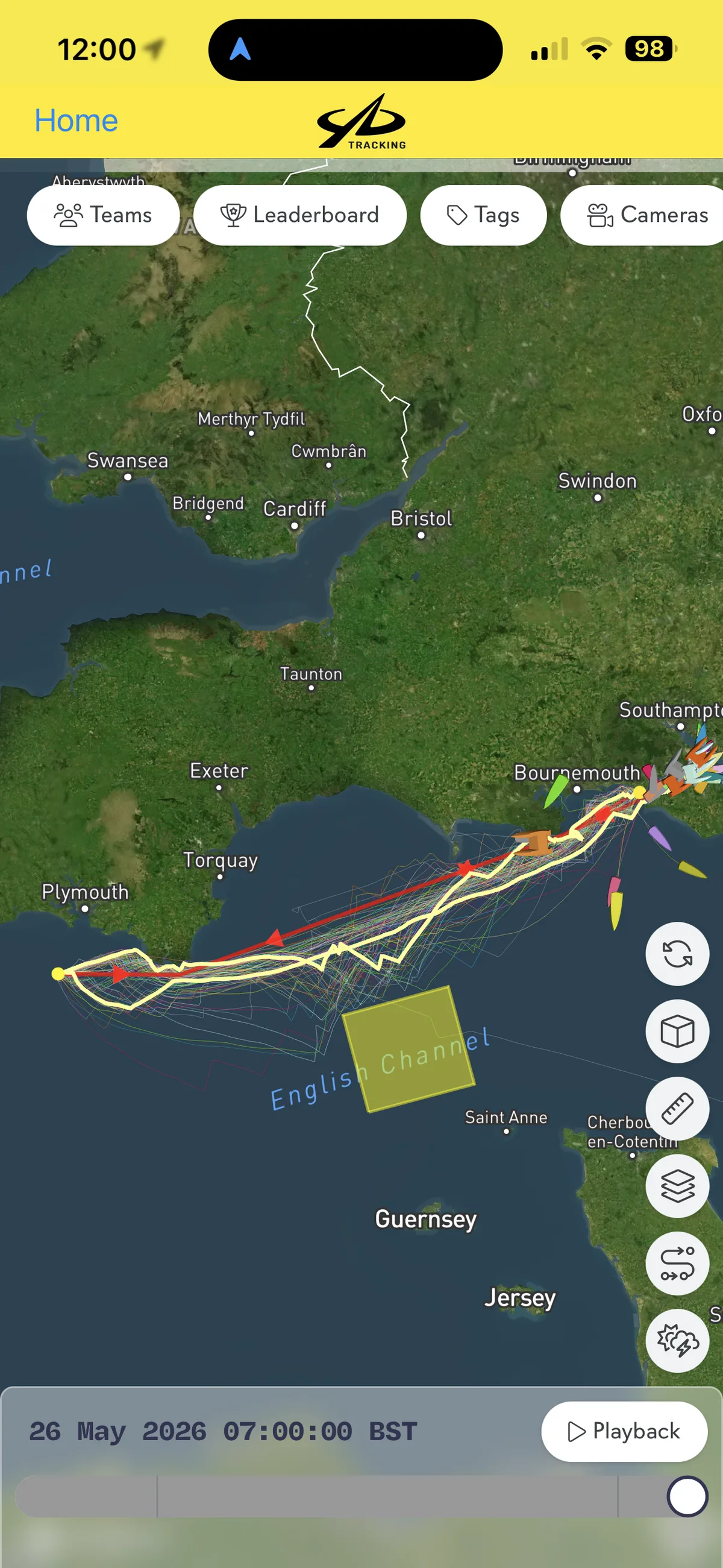
The race itself is one of the classic RORC Channel races, from Cowes to the Eddystone Lighthouse and back to North Head, around 235 nautical miles. It is long enough to become a proper offshore test, but short enough that crews often try to race it flat out from start to finish.
In the run-up to this year’s race, a complicated high-pressure system had been moving very slowly over the UK. In fact the weekend became one of the hottest May’s on record with 30 degrees in many places. So the forecasts looked light, unstable and difficult and because the week before had been cold and wet probably a lack of any sea breezes in the afternoon to spice things up. The day before the original start time was changed, and Class 3, the class we were racing in, eventually went off at 1450. This was to enable the race to have a west going tide during the late afternoon and evening taking the fleet past Portland Bill which is notrious tidal gate.
Starting off the Royal Yacht Squadron line from Cowes we beat west down the Solent. Our first big tactical decision was to work the north shore of the Isle of Wight. Most of the fleet chose the mainland shore. In retrpspect maybe not the best decision. By Hurst, the fleet had compressed. We were not exactly where we wanted to be, but we were still very much in the race and opted for an exit down the Needles channel more than half the fleet went north of the Shingles bank and this led to many taken a more northerely route across Poole bay in, a now, postive tide before tacking for Anvil Point.
Our first mistake was tacking to cover the fleet to the north when we had made major gains exiting the Needles via the Bridge buoy. That tack lost us the gains we had made. Having taken the Southern route out of the Solent I made my first slight error by tacking to cover the fleet to the North in anticipation of the fleet getting more wind inshore, in fact the opposite happened and my cover tack just lost us time. But we were in the top ten on the tracker even so.
From there, it became a close fetch down towards Start Point past Portland. We were 10 miles off the bill and reaching under our Code Zero headsail, this was replaced by a spinnaker as we past Start Point and then a run into the Eddystone. Conditions became light and sticky we went south with our symmetric spinnaker, our competing Sunfast 3600 all carried asymmetric spinnakers with bowsprits but as an older boat with a shorter sprit the boat was rated accorodingly. With a spinnaker pole we thought we might have been able to run deeper than other 3600’s but in reality the new asymetric spinnakes are so well cut our competitors were actually sailing just as low and perhaps faster than we were. We were overtaken by a some close competitors on this leg, however, we arrived at the Eddystone like house just after lunch on Sunday.
The leg back from Eddystone to Start Point - amazing sailing under the cliffs On the way back from Eddystone to Start Point we had a beautiful 10 to 12 knot breeze and a proper beat east. Most of the fleet, including us worked into Start Point and Salcombe before heading offshore again towards the traffic separation zone. The wind lifted us close to the cliffs and we could tell the moment it happened by the change in temperature of the wind over the deck as we sailed into the zones close to the cliffs. This we took advantage of and gained some time. Once past Start Point for the second time it was a long port leg, on the wind south east towards the Casquets TSS (Traffic seperation scheme).
That was where the race began to change.
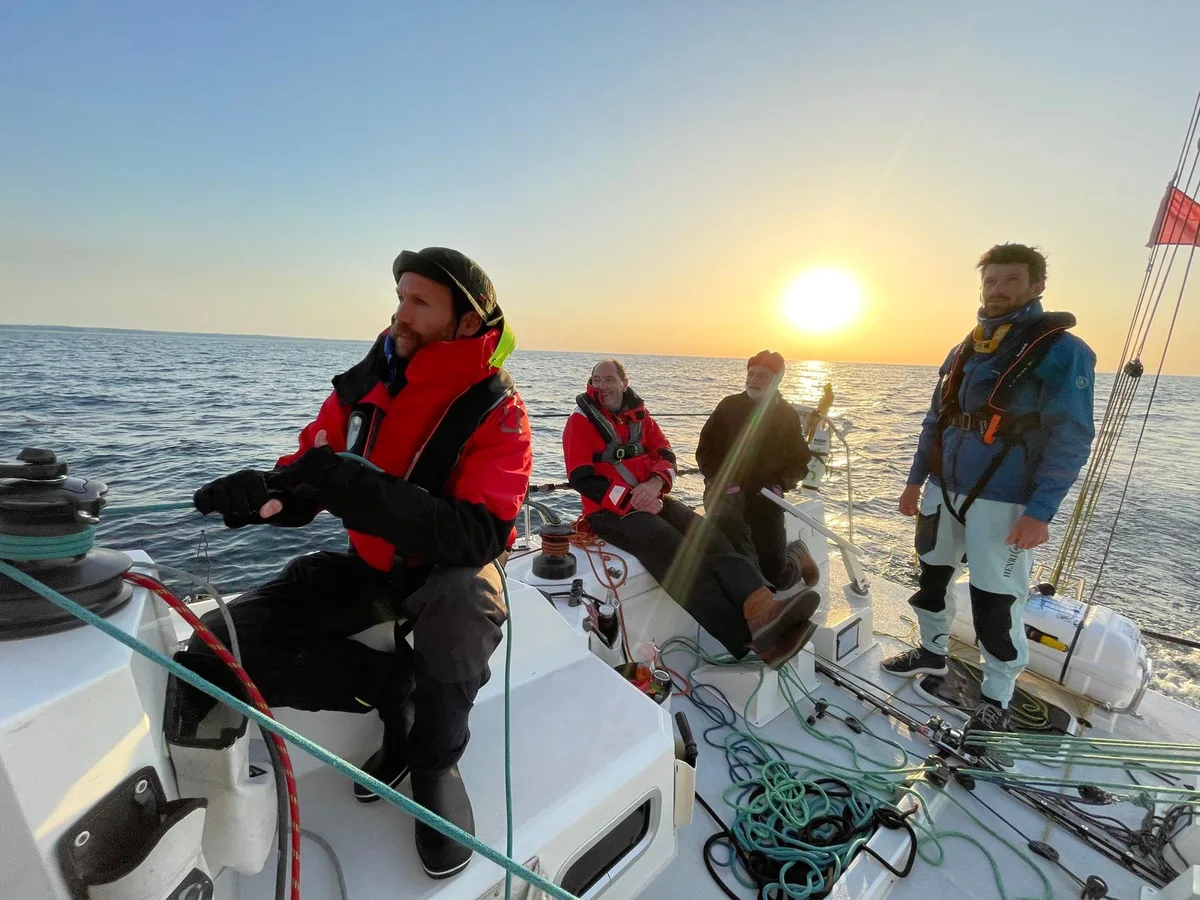
It was night. The wind was light. We had half a moon until 2.30am then complete darkness. The fleet was making small tactical decisions, tacking North then tacking back as the heading went left and the wind went light, small differences in angle, height, pressure and timing. Nothing looked dramatic. But in light air, nothing has to look dramatic to be decisive.
In reality we were racing a fairly old, but well equipped, Sun Fast 3600, perhaps one of the first. The sails were not the newest and the boat is probably not quite as quick as some of the better optimised 3600s in the fleet as it has raced thousands of miles over many years. But we were doing well, still in the top fifteen in class and overall. For much of the race, we appeared to be holding somewhere around eighth to twelth overall and in a similar position in Class 3. Class 3 itself seemed to be having a strong race in the overall position tables.
With the final tack north by Portland Bill we were still in the game.
We were 10nm miles off, then worked in towards St Alban Head and along the cliffs, to stay out of the building west going tide, with a few other yachts in our class. We were still holding a decent position. The next question was how to get back towards the finish line at North Head, north of the Needles Channel, with the breeze becoming softer and the tide becoming increasingly important.
Some boats went further offshore. Some stayed closer to the rhumb line and tried to keep reaching or beating towards the finish. Off Durlston Head and Old Harry rocks the wind became very light and we made the decision that, in hindsight, cost us the race.
Tacking under St Alban Head to avoid the tide and gain on the increased wind pressure (katabatic wind) My instinct had been to go further East but it was slow going. We even rigged the code zero in anticipation of sailing low and fast towards the east, we had already born away to increase speed.
Instead, we tacked north, looking for pressure or some kind of thermal effect in Poole Bay. We were looking for an option to do something different that could really get us on the podium. We were over-thinking perhaps and maybe were not being logical. I discussed this later in the article.
Result, we sailed straight into a wind hole.
Then we started going backwards with the tide.
That is when you know the race has changed its opinion of you.
The BIG tactical mistake
We put a kedge down to hold our position. To the south of us, other boats were still moving slowly east. Not fast, but moving. When a few knots of breeze eventually returned for us, we tried to recover the kedge and could not get it off the bottom. In the end, we had to abandon it. Lost another 15 minutes.
By then, the damage was done.
We had dropped more than ten places. What had looked like a good race, perhaps a very good race for the age and speed of the boat, had become a slow, painful lesson in light-air judgement. When the tide eventually turned and the wind filled again, we made our final approach and finished at around three o’clock in the afternoon.
However, a superb learning experience for all involved, close racing, full on day and night in one of the RORC's most historic Offshore challenges. An experience never to be forgotten.